Showing posts with label herbs. Show all posts

Thursday, 12 June 2014

Gyoza in Peanut Sauce with String Beans, Mushrooms and Basil (Japanese-Indonesian) My go-to recipes for Gyoza and Peanut Sauce!


Hello!  Yesterday, my boyfriend didn't have lunch because he was finishing work early, so we kind of ate a full lunch at 4.  By 8-9PM, we still weren't hungry but I needed some food (not junk snack) to take with my pills so I came up with this recipe, which is not really a recipe but more of an idea, using elements that are recipes from other talented people.  Nonetheless, it was super good, like good enough to post about it and cook it again many times in the future.  Here's what you need:


-some frozen dumplings of your choice, homemade or store-bought* (for this light meal, I used 6 dumplings per plate)
-some peanut sauce**
-coconut milk, optional
-vegetables (I used white mushrooms and green beans that I steamed in the microwave in a bowl with a little water covered with cling film, but leave a small opening for the steam to escape, and cook for a minute or two for al dente vegetables.  You could also use other vegetables, I thought of tossing some raw spinach at the same time as you add the peanut sauce at the end for example...)
-loads of basil if you like it (it really goes well with the peanut sauce, after I took the pictures, I dumped a bunch of leaves on my plate!)  I used Thai and Magic Mountain basils, try different mixes if you too grow basil!

*I used Japanese gyoza, I make 2-3 times the recipe and keep them in the freezer for months!  My go-to recipe is from Chef of Cooking with Dog, here's the video!: http://youtu.be/r8MBX-SXnmg
**I finally found a really good Indonesian peanut sauce.  The recipe makes a good amount that keeps for a week. It says to dilute the paste with 2cups of water, but since I wanted to use it as a dip too, I used only one cup of water.  To make the peanut sauce, I used some of the dip and diluted it with coconut milk until the consistency was to my taste. I took the recipe here, the salad looks good too!: http://dailycookingquest.com/by-cuisine/indonesian/pecel-madiun-vegetables-in-peanut-sauce


Cook the dumplings in a potsticker fashion. If you don't know what that means: pour some oil (don't use sesame oil, it will overpower the peanut sauce) in a non-stick pan and place the dumplings standing.  Let their bottoms get golden-brown, then add water up to a quarter of the dumplings height and cover.  Let steam for about 8 minutes or until they're cooked and the water mostly evaporated (if there's still a lot of water after 8 minutes, put the cover on the pan with a little crack open and pour out some water, it happens sometimes, even to me).  Uncover and let the water totally evaporate and the dumplings' bottoms get brown and crisp again.  With a paper towel, wipe any excess water and oil or burnt pieces off the pan, then add your veggies and peanut sauce, and stir 30 seconds until warmed through.  Plate and top with a generous amount of basil leaves!


Wednesday, 21 May 2014

My Quang Tom Thit and Homemade Ho Fun Noodles (Vietnamese, Thai) Mi Quang Noodles with Pork and Shrimps and homemade Steamed Rice Noodles


When I saw the picture for this recipe, I was attracted by the two different types of noodles, and the beautiful shrimps.  On top of that, when reading the recipe, I noticed the broth that's like a tomato pork broth.  While eating it, it really reminded me of the taste of a good spaghetti sauce with pork, like my Aunt's husband made for us, several summers ago.  This dish is amazing, you definitely need to try it.


So as usual, I took this from the best source of Vietnamese cooking videos, DanangCuisine.com / Helen's recipe on YouTube.  Unfortunately, she doesn't mention the fact that there's two types of noodles in the dish anywhere...  But I wanted to reproduce it like the picture because it seemed so good, so following, you'll find my recipe for homemade Ho Fun noodles.  If you decide to use both noodles like I did, cook half the amount of noodles that Helen suggests and replace the other half by two recipes of my Ho Fun noodles!  Here's the Mi Quang recipe!:

http://danangcuisine.com/recipes/recipe-24-cach-nau-mi-quang-ga-chicken-mi-quang/


Making the noodles is really easy and not that long, if unlike me, you got 2 flat trays.  On top of that, the noodles are already cooked, so think of the time you'll save when it's time to cook your pad sew or whatever, you won't have to use a burner-space and have to boil these noodles last minute, then drain them, rinse them, cool them. They require ZERO kneading, the quantities, unlike with wheat noodles, don't need to be adjusted.  Also everything is better fresher and homemade!  I wrote down the recipe here for convenience, but  I totally started with this recipe (then developed my own way) from this cooking channel on YouTube, the video will help you with the visual, watch it!:


(serves 2 - I used it for 4 bowls of Mi Quang since it has 2 different types of noodles)

-1/2cup tapioca starch
-1cup rice flour
-1 1/2cup of water
*See?  So easy to remember!

Start boiling water in a steamer.  In a bowl, mix the rice flour and tapioca starch with a whisk.  With that same whisk, add a little water at a time and incorporate well, then add more water until it's finished.  It helps getting rid of pockets of flour and starch so your batter will be smooth.

Now you'll need to prepare this:
-keep your whisk and a ladle by your batter bowl
-1 or 2 trays is better, they have to have a bottom that's totally flat, so your noodles are flat and even, also they can be square or round but they need to fit in the steamer
-some oil in a tiny bowl and a brush
-1-2 paper towel sheets
-a butter knife 
-a flat plate or cutting board to pile your noodles, lightly greased with oil

Start by brushing your first (or only) tray with oil and remove the excess by rubbing with paper towel.  This is really important, don't skip it!  Add a little batter.  Depending on your trays' surface, it might be different.  You'll need to adjust it the first couple noodles, but you'll figure it out fast.  You just want a thin layer to cover your tray completely, but you don't need that much batter: when you put the tray on the steamer, jiggle it a little and as the batter cook, it will stick (after 2-3 seconds) and just make sure the bottom of the tray is covered with batter before you put the lid on your steamer.  My stove is uneven so I put a butter knife under one side of the noodle tray to even it a little better.  You'll figure it out.

After a minute or two, when there's no more bright uncooked white spots on the sheet, it's ready!  If your noodle sheet is cracked, check on the next one earlier, it happens only when you overcook it I think.  Remove the tray from the steamer (and put your second one if you have it), brush the surface of the noodle with oil then run the butter knife around the edge.  You don't need to go all around, just make enough space for your fingers to fit on top of the tray, under the noodle sheet.  I use both hand.  Then, with confidence but delicately, pull the noodle slowly towards you and nicely place on the oiled plate. Repeat until the batter is done, whisking the batter each time before pouring some on your tray since the starch tends to settle at the bottom.

Cut your noodles to the wideness you like and separate them or use the whole sheets to make fresh rolls (I'll add a link here to a recipe I'll post later).  If using the same day, keep them covered in cling film in a fresh corner of the kitchen.  You can keep them in the fridge for a couple day, but only if you didn't cook them in a dish yet, or you're gonna microwave the leftover.  By that I mean that if you make cold rolls filled with raw veggies, herbs and lettuce, that you can't really microwave the day after, they'll become stale after being in the fridge.  Also, if using the noodles after a day or more, I would recommend keeping them on the plate with cling film in the fridge as they are, and cut them before cooking.

I think my tray was, maybe, 6".  I made this recipe twice and it made 7 sheets each time.  The first time I made them, I ruined a noodle sheet, and the other ones weren't perfect, had cracks.  But the second time, I felt like I already mastered this recipe and I knew it by heart. All sheets looked perfect.  

That might seem like a lot, but I really wanted to include all my observations, so your first time is perfect!  In reality it's the simplest kind of noodles to make, way easier than pasta (my recipe here: http://sunnysdelights.blogspot.com/2014/04/homemade-egg-noodlespastas-basics.html) or udon noodles, almost foolproof. And if you start your steamer first thing, it's really fast too.  Enjoy cooking! 

 (I act like somebody will actually read and try this.  I guess that's what blogging is...  That'd be cool if someone did try it though!)


I made Mi Quang lunches with leftovers!  Just plate everything but the broth the same way as in a bowl, and put the pork sauce in another container.  You can get out the noodles an hour before your lunch break so they are less cold, and microwave the sauce when ready to eat, pour it over the noodles and enjoy!  Don't microwave the noodles because of the fresh greens at the bottom.


Tuesday, 20 May 2014

Bo Cuon Nem (Vietnamese) Beef Rice Noodle Sheets Rolls


When I learned how to make steamed rice noodle sheets, I had to make this recipe I was keeping for the day I'd find the sheets at the grocery store, which never happened.  But no problem now, it's most likely even better with homemade noodles! You can find a (REALLY) detailed recipe for the noodle sheets with instructions on another post I wrote, here: http://sunnysdelights.blogspot.ca/2014/05/my-quang-tom-thit-and-homemade-ho-fun.html.  The best part: you only need rice flour, tapioca starch and water!  And it's fun and pretty fast, and the noodles don't require to be boiled afterwards! For the rolls I was inspired by a recipe I found in Vietnamese Street Food by Tracey Lister and Andreas Pohl, but I changed enough about it to say it's my own I think.  Hope you'll give it a try, a nice, easy, cold dish for this horribly hot summer (add incredibly humid if you're in Montreal, and its North and South shores like us).


(serves 3 - on the picture, I used this recipe for 2 and it was a little too much, and the rolls don't keep good in the fridge at all)

-200g pretty without fat piece of beef, thinly sliced into strips
-2 garlic cloves

-1 recipe rice noodle sheets (http://sunnysdelights.blogspot.ca/2014/05/my-quang-tom-thit-and-homemade-ho-fun.html) or 6 store-bought rice noodle sheets
-lettuce ripped in large pieces
-herbs (the recipe suggests mint and cilantro, I used perilla, basil, mint and parsley, I don't know if the classic Bo Cuon Nem always have mint and cilantro only...)
-1 carrot cut into thin juliennes
-1 cucumber without seeds, cut into thin, long matchsticks
-fried shallots
-Optional: I added some chopped thai red bird's eye chillies for topping
-nuoc-cham (I use Helen's recipe here: http://danangcuisine.com/recipes/recipe-2-vietnamese-dipping-sauce-cach-pha-nuoc-cham/)

Marinate the beef with garlic for 15 minutes to hours. Cook the beef in a pan, and get all your ingredients ready!

The book says to lay down each ingredients one by one on the rice sheets.  For better presentation and convenience, I suggest tossing together all your ingredients in a bowl!  Then lay about a 6th of the mix at the base of a rice noodle sheet, roll tightly, then cut in the center into two shorter rolls.  Finish your ingredients, pile the half rolls on plates, top with shallots and chillies if using, and dip in nuoc-cham!

Optionally, I would try marinating it with other Vietnamese ingredients, maybe fish sauce, pepper, honey, oyster sauce... But would it still be called Bo Cuon Nem? I'm not a big fan of non-marinated, non-saucy meat, but just garlic makes this recipe simple and fast, and good for steak-loving readers!


Monday, 19 May 2014

Bun Vit Xao Mang and Nuoc Mam Gung (Vietnamese) Duck and Bamboo Soup and Ginger Dipping Sauce


I decided to start choosing meals for the whole week and do groceries according to the menus because we're a little broke lately.  It also helps not wasting any vegetables or meats your forget at the back of the freezer.  Anyway, one of my menu was a duck and bamboo soup.  As my boyfriend and I were searching for dried bamboo at the Asian market (ran by Vietnamese people), a man placing products offered to help us.  He asked me what I was gonna do with the bamboo, I told him a soup.  He spotted the duck in our cart and he knew instantly which soup I was gonna cook!  He said "But how do you know about this soup!?" And I told him I've been cooking Vietnamese for 2-3 months now.  He was so really proud!  Yaaayyy!  He brought me in another row and suggested I bought vacuum-sealed fresh bamboo in brine, that my soup would be much better.  When we left, my boyfriend told me he thinks that man was the owner!  I should get an easy, steady job there maybe, with air conditioning for the summer...

Turns out the duck soup recipe calls for both dried and brined bamboo (I overlooked the brined one). I only used the fresh brined one, but I included the instructions if you want to use only the dried one, or both.  So here is my simplified version of Duck and Bamboo Soup from the book Vietnamese Street Food by Tracey Lister and Andreas Pohl!


(serves 6)

Broth:
-2 chicken carcasses
-1 duck
-4cm piece of ginger, roughly sliced
-6 green onions
-2 white parts of lemongrass, bruised
-1tsp salt
-1tsp sugar

Seasoning
-1 1/2tbsp fish sauce
-3cm ginger, thinly julienned

Toppings:
-6 portions (600g) rice vermicelli
-120g vacuum-sealed bamboo, drained, boiled for 15 minutes, then rinsed in cold water, dried and thinly sliced
-(optional) 60g dried bamboo, soaked overnight then boiled for an hour, then refreshed and drained, cut into 1 1/2" pieces
-some basil
-some mint
-4 green onions, thinly sliced
-fried shallots
-Nuoc Mam Gung (ginger dipping sauce), recipe follows

In a large pot, add the chicken bones and duck and cover with water.  Bring to a boil, skim the scums, then add the other ingredients on the broth list and lower the heat.  Simmer for an hour, removing the fat and scums regularly.  After an hour, remove the duck, let it cool before cutting with a cleaver or simply deboning it like I did, and let the broth simmer an extra hour.

Prepare all your toppings, the ginger dipping sauce, and cook the rice vermicelli.  After a total of two hours, strain the broth, discard everything.  Put back on the stove in a clean pot, add the seasonings and bring to a boil.  

To assemble the dish, place a portion of noodles at the bottom of each bowls (it makes enough for 6, but you can also just keep the extra broth in the fridge or freezer for later and adjust the toppings amount, it's just me and my boyfriend here so that's what I did, made lunches, kept extra broth for sides of soup during the week), top with the duck, bamboo, herbs, and finish with green onions, shallots and a spoon of dipping sauce.  Bring the dipping sauce at the table for your guests to adjust to their taste.

GINGER DIPPING SAUCE:
-120mL fish sauce
-1tsp sugar
-2cm ginger, peeled and cut into tiny, tiny thin strips
-3 garlic cloves, chopped
-1 long red chilli, finely chopped

Mix the fish sauce and sugar until well combined, then stir in everything else.  You can use any leftovers on rice, or as an alternative to the classic nuoc-cham...


Wednesday, 14 May 2014

Lemongrass Beef Plate with Rice Papers (Vietnamese)


I love plates that are full of different items.  I also love lettuce wraps and rice sheet wraps!  This bowl has lemongrass beef, rice vermicelli, herbs, pickles, cucumbers, fried dried tofu, nuts...  Everything you need for a perfect spring roll.  The beef recipe I took from this book.  It was meant to be served in a baguette, but I like my bowl better!  For the ingredients for the bowl, feel free to compose with what you like and have at home... But I wouldn't skip the herbs!

So here's the simplified recipe for Lemongrass Beef Skewers from the book Vietnamese Street Food by Tracey Lister and Andreas Pohl, followed by my own tips to make the perfect bowl!


(makes 10 mini skewers - serves 2-3)

Marinade for 300g nice lean beef, thinly sliced:
-2 shallots, chopped
-3 garlic cloves, chopped
-3 white parts of lemongrass, chopped
-1 long red chilli, seeded and chopped
-1tbsp roasted sesame seeds
-2tsp fish sauce

Grind together, in a mortar and pestle or in a food processor, the shallots, garlic, lemongrass and chilli.  When I use a mortar I always chop everything as small as I can to save time and energy.  When the mixture resembles some kind of rough paste, add slightly grounded sesame or grind in the mortar.  Add fish sauce, mix, and thoroughly massage the beef slices.  Let marinate for an hour to overnight in the fridge.

If using a grill, soak 10 short skewers in cold water for about 30 minutes.  When using a pan, you can skip this step.  Fold the beef slices repeatedly on the sticks to make 10 mini skewers, just enough each for one fresh spring roll.  Grill!


To serve, for EACH plate, I put enough ingredients for 5 rolls (5 lettuce pieces, 10 cucumbers...).  I ate only 3 rolls and kept two for lunch, it's a little big!:

-5 beef skewers
-some Dua Gop carrots and daikon pickles (recipe here: http://sunnysdelights.blogspot.ca/2014/05/banh-mi-with-pork-patties-and-dua-gop.html)
-5 pieces of lettuce
-1 portion rice vermicelli (I had fresh ones!)
-10 half slices of cucumber
-plenty of fresh herbs (just pruned my plants!)
-some chopped almonds or peanuts 
-pieces of dried tofu sheets (cut, deep-fry at at least 350F and drain on paper towels)
-nuoc cham for dipping (I use Helen's recipe, here: http://danangcuisine.com/recipes/recipe-2-vietnamese-dipping-sauce-cach-pha-nuoc-cham/)

Dip a rice sheet in warm water briefly, lay down on a flat plate, put a little of everything and a skewer (without the skewer haha) and roll tightly.  Dip in nuoc-cham, it's sooo good!


Sunday, 11 May 2014

Banh Mi with Pork Patties and Dua Gop, and recipes for Roasted Rice Flour and Annatto Oil (Vietnamese)


You know what fascinates me about Asian cooking?  Asians eat regular food for breakfast.  I mean here, most people have cereals, pancakes, lumberjack breakfast (with eggs, toasts, potatoes and 3 different kind of pork, baked beans), toasts...  But Asian people can start the day with rice and fish and it doesn't seem weird.  So for breakfast last Saturday, I made Banh Mi with Pork Patties!


I had a little extra money for once and treated myself (and indirectly my boyfriend, it helps with daily menus!) to two cooking books.  One of the books I bought, I realized was boring, so I went back to the bookstore and said I received it as a gift but already owned it, so they let me exchange it, phew!  So I exchanged it for Vietnamese Street Food by Tracey Lister and Andreas Pohl, and even though their names aren't Vietnamese, the food is authentic, the street pictures and stories are nice!

Without further intro, here are the two modified and simplified recipes for Pork Patties and Carrots and Daikon pickles, from the book Vietnamese Street Food by Tracey Lister and Andreas Pohl, followed by my easy recipes to make Roasted Rice Flour and Annatto Seeds Oil!


(for 3-4 Banh Mi sandwiches)

-600g ground pork
-1 1/2tbsp roasted rice flour (store-bought or homemade, recipe follows)
-3 garlic cloves, chopped
-2 shallots, chopped
-1tbsp fish sauce
-1tsp annatto oil (recipe follows)
-1/2tsp sugar
-1/4tsp salt
-1/2tsp black pepper

Mix everything together and let the flavours meld for about 30 minutes.  Shape into flat patties and grill!

I served these patties in a Vietnamese baguette with dua gop (carrots and daikon pickles, recipe follows), cucumber slices, sliced green and red thai chillies, and parsley (if you like cilantro, unlike me, use it, it's more authentic).  The book suggested forming the meat into little sausages around the end of short bamboo skewers, and serving them as a bowl with herbs, fried dried tofu skins, pickles, rice vermicelli, lettuce, peanuts...  And rice sheets!  The picture looks so good, I'm definitely trying it this way next time!


And here is a recipe from the same book for Dua Gop, carrots and daikon pickles.  I tried this recipe, and except for the brine amount that was too small (but I modified it in this transcription), to me, all recipes I tried gave a similar result, so here's just one amongst others!

(makes about 2cups)

-250g carrots (if unlike me you can find these wide fat carrots, it makes the work easier)
-200g daikon
-300mL rice vinegar
-1/2cup sugar
-3tsp salt

Peel and cut the carrots and daikon into batons, matchsticks, or whatever shape you like, as long as it's not too thick.  This time I made batons, and it was a lot of work, but the crisp is nice and the shape makes the pickles look playful, but whatever shape you choose will taste good.  Squeeze all veggies into a jar (about 2 cups).

Put the vinegar, salt and sugar together in a small saucepan, and warm until the sugar has completely dissolved.  Let cool down to lukewarm and add to the jar.  I leave the jar on the counter for one day to make the pickling process faster.  After one day you can eat and keep in the fridge!


Why buy ROASTED RICE FLOUR when you can make your own! Start with half a cup or one cup (if you use roasted rice flour often) of glutinous/sweet white rice. Put it in a pan or wok on low or med-low heat and keep on mixing for 10-20 minutes, until the rice turns golden.  Be careful not to use high heat and mix constantly or it WILL burn.  When it's ready, transfer to a bowl and cool down completely.  Grind nicely with a coffee grinder, food processor or a mortar and pestle if you have time and want to be authentic!  Store in an airtight container on the shelf.

What about ANNATTO OIL?  Annatto oil is almost essential for certain Vietnamese dishes, it gives a nice yellow colour.  But I don't think you can buy it, you have to make it.  Good news: it only requires annatto seeds and oil!  In a small saucepan, warm 1tbsp annatto seeds in 125mL (about half a cup) of vegetable oil over low heat.  When the oil just starts to simmer, remove.  Let cool down, strain and transfer to a jar!

Enjoy cooking!

Tuesday, 6 May 2014

Bulgogi Spring Rolls (Vietnamese-Korean Fusion)


Since I started cooking Vietnamese, we had fresh spring rolls only once!  In an effort to make it more often (and it's really easy to let everyone wrap their own with what they like - especially my boyfriend who's picky about his veggies), we tried these bulgogi spring rolls from Helen!  They marry delicious korean bulgogi beef (I used Maangchi's recipe!) and kimchi with fresh veggies and herbs like a regular Vietnamese fresh spring roll.  The dipping sauce is a mixture of what every dipping sauce should contain (peanut butter, gochujang, miso, honey...).


So this recipe was inspired by a recipe from Danang Cuisine/Helen's Recipes.  I forgot to add kimchi to mine, but I guess you can put whatever you want.  The sauce is really a must try!  The only real modification I made was to use Maangchi's bulgogi marinade, because it's my go-to bulgogi recipe and I know it's authentic!  

Helen's Bulgogi Spring Rolls Recipe:
http://danangcuisine.com/recipes/bulgogi-spring-rolls-goi-cuon-bo-han-quoc/


For Maangchi's delicious bulgogi marinade, plus instructions and video, go there:

http://www.maangchi.com/recipe/bulgogi


Overall it was really good, fresh, tasty and textural, the dipping sauce I might use for other filling combinations of spring rolls.  You should really try this recipe!

Thursday, 1 May 2014

Cha Gio (Vietnamese) Vietnamese Spring Rolls


I like filling the freezer with different dumplings and buns to keep for when I want an easy meal, or an easy extra side dish when friends come and eat at our place!  As a new fan of Vietnamese cooking, I still had to make Vietnamese deep-fried spring rolls!  I found this recipe from Steamy Kitchen (who took it from a book) and I was quite pleased with the results, except I would really suggest using only half the quantity of white pepper cause the taste is a little overwhelming.  I made one full recipe and ended up with 63 rolls!  Here's the link!:
http://www.steamykitchen.com/2456-vietnamese-spring-rolls.html


When eaten by themselves, the rolls are good wrapped in lettuce with some herbs and dipped in nuoc-cham.  With the rolls I made a bowl using herbs and lettuces, vermicelli, cucumbers, carrots and daikon pickles, Helen's (from Danang Cuisine/Helen's Recipes) recipe for her Bun Cha pork marinade (recipe here: http://danangcuisine.com/recipes/recipe-43-bun-cha/), my spring rolls and peanuts and fried shallots!  Top it all with nuoc-cham (recipe here: http://danangcuisine.com/recipes/recipe-2-vietnamese-dipping-sauce-cach-pha-nuoc-cham/)!


Thursday, 24 April 2014

Thit Kho Tau Bowl (Vietnamese)


My internet friend Gary made this recipe not even a week ago and I had to copy him!  Thit Kho Tau is pork belly and hard-boiled eggs caramelised and slowly simmered with a coconut juice and fish sauce based broth.  The pork is tender but still meaty, the eggs turned salty (in a good way) and the sweet broth is really good over rice.  I used Helen's recipe again, which you can find here:
http://danangcuisine.com/recipes/recipe-42-thit-kho-tau-caramelized-pork-and-eggs/

For the bowl, I used, from bottom to top:
-a mix of jasmine rice, forbidden black rice and thai cargo red rice
-scallion oil
-lettuce, mint, Vietnamese mint, basil and flat parsley, torn appart
-cucumber shoyu-koji pickles (to get the recipes to make shoyu-koji, and the pickles, go to the fermentation category)
-some Thit Kho Tau pork and eggs of course!
-top wit a generous amount of Thit Kho Tau broth

It was a quick meal since I simmered the Thit Kho Tau during the day, so I just had to make rice and microwave the pork and eggs.  I served it with Dua Chua because Helen says it's usually eaten with different pickles.  Recipe here:
http://danangcuisine.com/recipes/recipe-61-dua-chuado-chua-vietnamese-pickled-vegetables/


Tuesday, 22 April 2014

Bo Xao La Lot (Vietnamese)


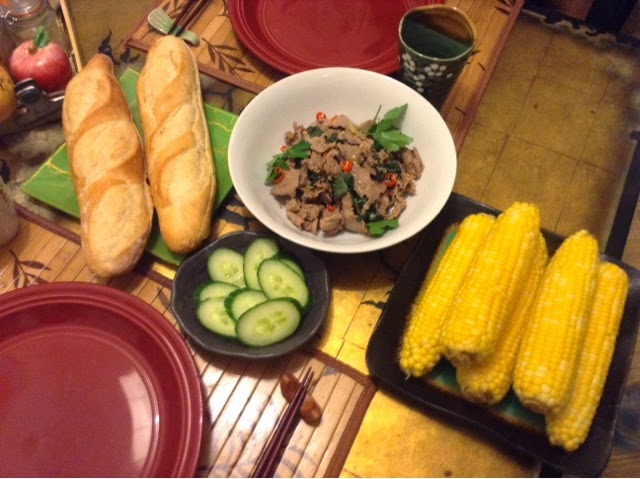
Yesterday for supper we had this really quick (10 minutes) beef dish made with lemongrass and chillies, and some seasonings.  I served it with corn, and even though you could tell it's not the season yet, it still felt amazing to munch on a cob.  Oh how I love you, corn.  

This recipe, as with most of my Vietnamese recipes lately, was taken from this marvellous book by Luke Nguyen called "The Food of Vietnam", that I suggest to anyone who likes Vietnamese food or doesn't know anything about it (like me before my boyfriend got me the book!).

(serves 2 to 4 as a side)

-2tbsp veggie oil
-1 white part lemongrass stem, finely chopped
-2 cloves garlic, finely chopped
-2 red bird's eye chillies finely chopped, plus one finely sliced for presentation.
-300g lean beef finely sliced
-1tbsp fish sauce
-1tbsp soy sauce
-2tsp sugar
-15 betel leaves, roughly cut
-cilantro (or parsley) to decorate

In a really hot wok, add oil and lemongrass and stir a couple seconds.  Then add chillies, garlic and beef and toss for 2-3 minutes.  Add the fish sauce, soy sauce, sugar and betel and toss until beef is cooked.  Plate and decorate with chillies and herbs.


In the book, this beef dish was suggested to be accompanied by rice, but from what I heard Vietnamese will wrap anything in lettuce, rice sheets or baguettes so I opted for half-baguettes since I knew that way my boyfriend wouldn't pick out the betel leaves.  It was a good choice since the beef was really spicy, and even though it was lemongrass and beef, which I never saw in a Banh Mi, it tasted really good and Vietnamese in the baguette.  If you're Vietnamese and you think baguette was a weird choice for this beef, try it, you'll love it!


Thursday, 17 April 2014

Chargrilled Salmon Salad (Vietnamese)


Tonight's supper is a salad of fresh herbs, pickles and marinated rare salmon with fried shallots and garlic chips and topped with peanuts and nuoc-cham. I served it with rice and kropek (shrimp crackers).  I thought it was amazing, but unfortunately my boyfriend doesn't like herbs or most veggies, so he ate only the fish, nuts and fried shallots and garlic and it made me feel horrible to throw out everything, but that's the price to pay when I want a salad, and that salad was worth it, so without more talking, here is "Chargrilled Salmon Salad" simplified and slightly modified, from the book "The Food of Vietnam" by Luke Nguyen.


(serves 2 people)

Marinade for 200g salmon fillet, skin removed:
-1 garlic clove, chopped
-2tsp sugar
-1 1/2tbsp fish sauce
-1 red bird's eye chilli, chopped

-150 g pickled vegetables (I didn't use the recipe from the book, I used a mix of cucumber sticks and mostly Dua Gia pickles - not the ones on the picture, I changed my mind later - recipe here: http://danangcuisine.com/recipes/dua-gia-vietnamese-pickled-bean-sprouts-recipe/)
-1 handful watercress, roughly cut
-a couple perilla leaves, mint, parsley...  roughly sliced
-1tsp fried garlic chips (recipe follows)
-3tbsp nuoc-cham (I use this recipe: http://danangcuisine.com/recipes/recipe-2-vietnamese-dipping-sauce-cach-pha-nuoc-cham/)
-1tbsp roasted peanuts
-some fried shallots
-one bird's eye chili, thinly sliced


First, mix everything for the marinate until the sugar has dissolve.  Coat the fish and marinate in the fridge for 20 minutes to a couple hours.


Meanwhile, let's make the garlic chips.  Slice some garlic as thinly as you can (you only need a tsp for the recipe, but if you want to fry more, it keeps well).  Heat some oil to medium high, enough to contain the garlic, then fry the garlic until slightly golden and remove fast and let dry on a paper towel.  When the oil is drained, they'll become crisp.  If you don't have store-bought fried shallots like me, you can use this recipe to fry shallots too!

When you're ready to eat, grill your salmon (I used an oiled ridged pan) and char the salmon only 2-3 minutes on each side, keeping the center rare.  Remove from grill or pan and let cool down and rest 5 minutes.

Flake the salmon in a bowl with the watercress, herbs, pickles, garlic chips and nuoc-cham, mix everything together and top with peanuts, fried shallots and chillies!

And there you have it, a fancy-ass restaurant style salad!


Bun Thit Nuong (Vietnamese)

Yesterday for supper I made some Bun Thit Nuong for the second time, but with a different recipe, taken from The Food of Vietnam by Luke Nguyen.  It was delicious!  The original recipe calls for pork neck, but since I couldn't find pork neck anywhere, I bought pork shoulder, which I've never cooked with before.  As I sliced a half-frozen piece, each slice would break because of all the fat.  I marinated the meat overnight, and when I was ready to skewer, I started doubting that I'd enjoy the meat just because of all that thick fat.  But once "grilled" (I only have a ridged pan - I still love that pan, a gift from my aunt Myriam), the fat was totally gone!  Only one bite I had some unchewable piece, but the rest was only meaty!  I guess next time I won't be as scared of trying new cuts of meat. 

About this recipe, it uses the most Vietnamese ingredients: fish sauce, pork, rice vermicelli, herbs, nuoc-cham, fried shallots.  It's so tasteful, one of my favourites!

So here is the Bun Thit Nuong recipe, adapted from "Chargrilled Pork Neck with Vermicelli Noodles", from the book "The Food of Vietnam" by Luke Nguyen.


(Serves 2 hungry people)

Marinade for 500g of thinly sliced pork neck, shoulder or fillet:
-2tbsp sugar
-4tbsp fish sauce
-1tbsp honey (I used barley malt syrup for colour and caramel taste)
-6 green onions, white parts puréed in a mortar, green parts finely sliced and reserved for the scallion oil
-2 garlic cloves, chopped
-2 tbsp vegetable oil
-6 bamboo skewers or more, soaked in cold water for 30 minutes if you use a grill (I used a griddle pan so it wasn't necessary)

Scallion oil:
-reserved sliced green parts of green onions
-1 cup vegetable or canola oil (avoid coconut oil since it hardens in the fridge)
-a pinch of salt and/or sugar (optional)

-2 portions rice vermicelli, cooked
-1-2 handfuls herbs (different mints and basils, perilla, cilantro if you like but I don't so I always replace it with flat parsley...)
-about 10 cm cucumber, sliced 
-1-2 handfuls bean sprouts
-nuoc-cham (dipping fish sauce - I use this recipe: http://danangcuisine.com/recipes/recipe-2-vietnamese-dipping-sauce-cach-pha-nuoc-cham/
-fried shallots for garnish
-roasted peanuts for garnish

Combine all marinade ingredients (except the skewers haha) together and marinate the meat for a couple hours to overnight.

For the scallion oil, put oil and scallions, plus salt and sugar if using in a small pot on low, and remove when it starts boiling a little, cool down and keep in the fridge for days.

Skewer the meat by folding on the sticks, then leave at room temperature for 30 minutes (when I don't, the meat in the center doesn't cook properly by the time the outside is charred).  Grill until nicely charred on all side.  You can cook the vermicelli at the same time.

To assemble, start with the vermicelli, then disperse the herbs, cucumber and bean sprouts.  Add skewers on the side and garnish them with some scallion oil.  Garnish the plate with fried shallots and peanuts.  Top everything with nuoc-cham.  You can eat as a bowl or serve with lettuce leaves or rice sheets, putting a little of everything in the leaf or sheet.  

Last time I made Bun Thit Nuong with this different recipe and it looked like this, it was delicious too and it has a video!:


Bun Cha (Vietnamese)

Another Vietnamese recipe from Helen: Bun Cha.  Chargrilled marinated pork belly and patties, served with rice vermicelli, lettuce, herbs and deconstructed nuoc-cham with delicious pickles, and all is in the same recipe!  To eat, prepare you nuoc-cham bowl by adding some meat to it, some pickles and some garlic and chilies.  Take a little lettuce, herbs and vermicelli, drop in the nuoc-cham bowl and pick back up with some meat and pickles!  Crazy good!

Here's the bun Cha recipe!
http://danangcuisine.com/recipes/recipe-43-bun-cha/